AI for Solo Business Owners That Actually Helps
AI For Businesses
AI for solo business owners works best when it cuts admin, improves delivery and builds repeatable systems without adding more software chaos.
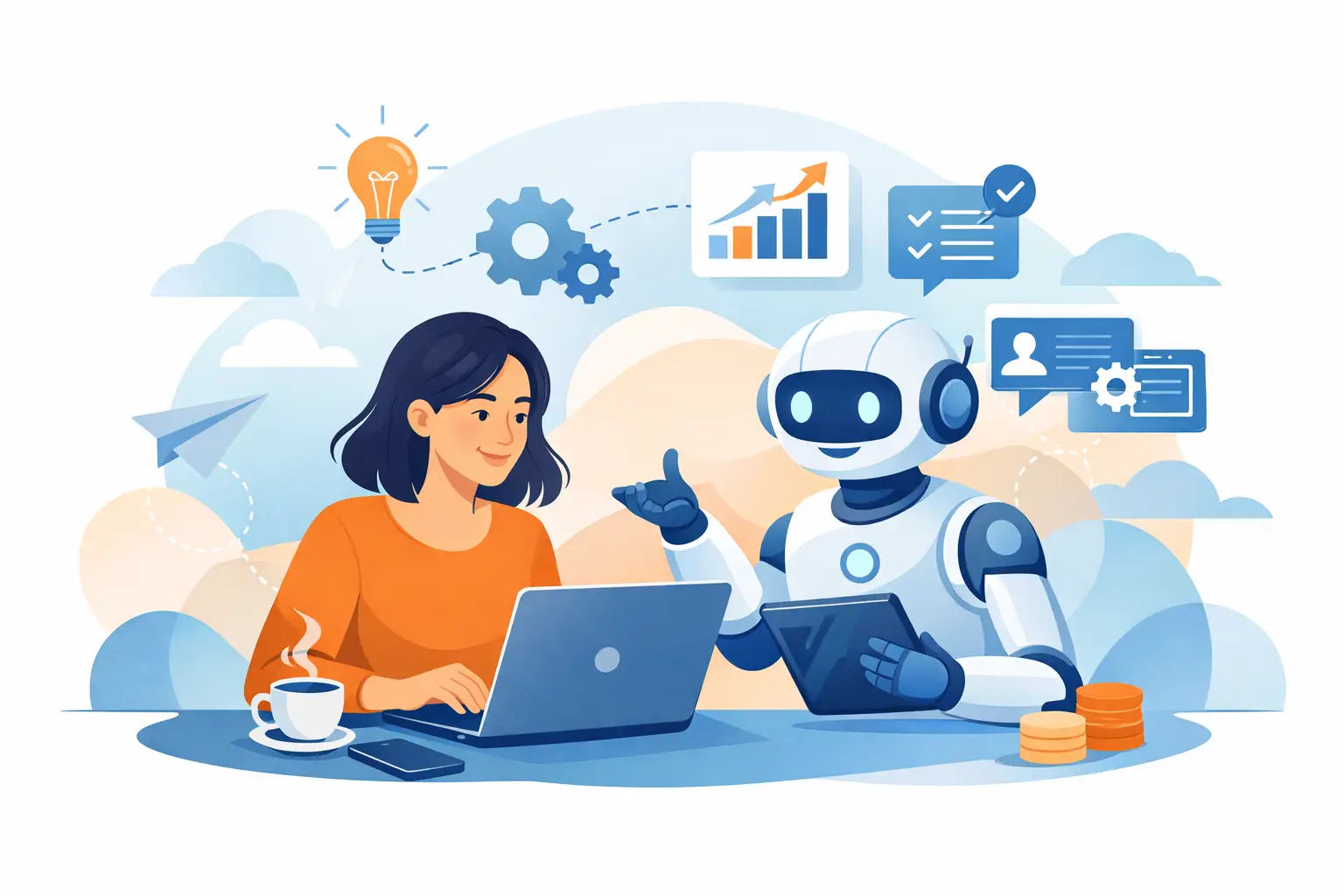
If you run a business on your own, you do not need more ideas. You need fewer bottlenecks. That is where AI for solo business owners starts to make sense - not as a shiny add-on, but as a practical way to clear admin, tighten delivery and stop everything depending on your memory.
Most solo founders are carrying out three jobs at once: selling, delivering and running the business. The problem is not effort. It is context switching. One minute you are replying to an enquiry, the next you are writing a proposal, then chasing an invoice, then trying to remember what was agreed with a client last Tuesday. AI can help, but only when it is applied to the right parts of the business.
Where AI for solo business owners actually earns its keep
The best use of AI in a one-person business is rarely the flashy use case. It is the repeated, low-value work that quietly eats two hours a day. Admin, drafting, sorting information, chasing next steps, turning notes into usable actions - that is where the return tends to show up first.
If you are a consultant, freelancer, coach or service provider, your business probably runs on a set of informal workflows. Leads come in by email or WhatsApp. Notes live in a notebook, a Google Doc, or your head. Proposals get copied from old versions. Follow-ups happen when you remember. None of this means the business is broken. It means it has grown around you.
AI is useful when it gives structure to that sprawl. It can draft first versions of proposals, turn meeting notes into actions, summarise client calls, create follow-up emails, categorise enquiries, prepare content outlines and help standardise delivery. Done well, that removes drag without making the business feel robotic.
The real goal is not more tools
A lot of solo business owners assume AI means buying another subscription. Usually, that is the wrong starting point.
The real question is this: where are you losing time, dropping balls or delaying work because the process lives in your head? Once you know that, you can decide whether AI belongs there. Sometimes the answer is yes. Sometimes the process is so unclear that adding AI too early just creates faster confusion.
This is why tool-first adoption often goes nowhere. You sign up for a few platforms, test them for a week, get some decent outputs, then abandon them because they are not connected to how the business actually runs. You have not built a system. You have added software.
For solo operators, the priority should be a small number of useful workflows. One tool you actually use is better than five tools you keep meaning to learn.
Start with pressure points, not possibilities
There is no prize for using AI in every part of the business. Start where the operational pressure is highest.
For some people, that is lead handling. Enquiries arrive, but responses are inconsistent and follow-up is patchy. AI can help draft replies, classify leads by type, and prepare tailored responses using a standard structure. That does not replace judgement. It simply means you are not writing from scratch every time.
For others, the bottleneck is delivery. If you spend hours each week preparing reports, summarising calls, pulling actions together or turning rough notes into polished output, AI can shorten that gap. A good setup can turn a recorded call and a few prompts into a client summary, internal checklist and draft next-step email in minutes.
Then there is the hidden work of running the business itself. Invoicing, planning, documenting processes, writing SOPs, sorting research, preparing social posts, chasing overdue actions - none of it is difficult, but all of it steals focus from paid work. AI can reduce the weight of that workload, especially when combined with a few sensible automations.
What good implementation looks like
Good implementation is boring in the best possible way. It fits around your existing work, uses your accounts, and leaves you with something you can keep running.
That usually means starting with one or two workflows and tightening them until they are reliable. For example, you might create a standard process for enquiry handling: incoming message, AI-assisted qualification, draft response, follow-up reminder, proposal template. Or a delivery workflow: meeting recording, summary, action list, project update, client follow-up.
The important part is that the workflow is yours. The prompts, templates and logic should reflect how you work, what you sell and how you speak to clients. Generic AI outputs are fine for a first draft, but they are not a business system.
This is also where many solo business owners need support. Not because they cannot use the tools, but because they do not have the time to map the workflow properly and build it into something repeatable. That is the gap between experimenting with AI and actually benefiting from it.
The trade-offs nobody mentions
AI can save time, but it also introduces decisions. You still need to check outputs, protect sensitive information and avoid building processes around weak assumptions.
If your service depends heavily on judgement, nuance or compliance, you cannot just hand work to a model and hope for the best. Drafting is one thing. Final accountability is another. A proposal generated by AI still needs your commercial judgement. A client summary still needs to be accurate. A content draft still needs your voice and expertise.
There is also a risk of over-automation. Solo businesses often win because they feel personal and responsive. If every client touchpoint becomes templated, you can lose the sharpness and trust that made the business work in the first place. The aim is not to remove you from the process. It is to remove unnecessary repetition.
Then there is software sprawl. It is easy to end up with a chatbot, a note taker, a writing tool, an automation platform and a CRM all doing overlapping jobs. That adds cost and confusion. In many cases, a simpler stack with clear workflows will outperform a bigger stack with no structure.
A sensible way to assess AI for solo business owners
Before you pay for anything new, look at your last two working weeks. Where did time disappear? Where did work stall? Where did you repeat yourself?
If you see the same tasks turning up again and again, that is your shortlist. Pay particular attention to work that is necessary but low-value: writing routine emails, summarising meetings, preparing standard documents, pulling together updates, organising notes, drafting content from existing material. Those are often strong candidates.
Next, separate tasks into three groups. Tasks that need your judgement. Tasks that need your tone but not your full attention. Tasks that are mostly admin. AI is strongest in the second and third groups. That framing stops you trying to automate the parts of the business that clients actually pay you for.
After that, test one workflow properly. Not ten. Pick something measurable. For example, reduce proposal drafting from ninety minutes to twenty-five. Or turn post-meeting admin from forty minutes into ten. Or cut lead response time in half. If the workflow saves time consistently and the quality holds up, keep it. If not, adjust it or drop it.
Why solo founders get the most value from structured help
The biggest constraint in a solo business is not lack of ambition. It is lack of spare capacity. You are already doing the work, so building better systems often gets pushed down the list.
That is why structured implementation matters. A practical partner can help audit what is really happening, strip out tool clutter, design workflows around your actual business and build them in a way you own. That is more useful than a strategy session full of possibilities you will never have time to implement.
For solo founders who want momentum, the best support is steady and operational. Plain English, no hype. Useful systems. Clear priorities. Measurable gains. That is the difference between AI as background noise and AI as part of how the business runs.
If you are curious about AI for solo business owners, start small and stay commercial. Pick the work that drains time but adds little value. Build one reliable process. Make sure it sounds like you, fits your business and leaves you more in control, not less. If that first change gives you an hour back every day, you will not need convincing about the next one.
Written by
AI For Businesses
The team at AI For Businesses helping UK companies adopt AI in practical, build-focused ways.
Enjoyed this article?
Get more practical AI tips delivered to your inbox weekly.