ChatGPT Versus Custom AI Workflow
AI For Businesses
ChatGPT versus custom AI workflow: what suits your business best? Compare speed, cost, control and long-term value for day-to-day operations.
If you have ever watched a team get excited about ChatGPT on Monday and then go back to spreadsheets, inboxes and bottlenecks by Friday, you already know the real issue. The question is not whether AI can help. It is whether ChatGPT versus custom AI workflow is the right choice for the way your business actually runs.
For most small and mid-sized businesses, this is where the noise starts. One option looks fast, cheap and easy to test. The other sounds more serious, but also more expensive and harder to define. The right answer depends less on the tool itself and more on the job you need done, how often it happens, and who needs to rely on it.
ChatGPT versus custom AI workflow: what is the difference?
ChatGPT is a general-purpose interface. It is excellent for drafting, summarising, brainstorming, rewriting, analysing chunks of information and helping a person think faster. In a business setting, that often means better emails, quicker proposals, improved meeting notes, rough first drafts of policies, and support with research or internal documentation.
A custom AI workflow is different. It is not just a chat window. It is a process built around a specific operational task, with inputs, rules, triggers and outputs designed for your business. That might mean an enquiry comes in, the system classifies it, extracts key details, updates a CRM, drafts a reply, flags urgency and sends the right information to the right person. The value is not only in the AI model. It is in how the whole workflow is organised.
That distinction matters. ChatGPT helps people do work. A custom AI workflow helps work move without depending on someone remembering the steps every time.
Where ChatGPT is the better choice
ChatGPT is often the right first move because it gives you speed. You can test ideas quickly, see where AI is useful and improve the quality of day-to-day output without a large project. For a founder, manager or operations lead trying to reduce admin this week, that matters.
It is especially useful when the task is variable, human-led and still needs judgement. If your team is writing proposals, refining client communications, turning meeting notes into actions or summarising long documents, ChatGPT can save meaningful time without any major build. It is also a good fit when your process is not stable yet. There is little point automating a workflow that changes every month.
The other advantage is accessibility. Most teams can start using ChatGPT with limited training. That lowers the barrier to entry and makes it easier to build confidence. Used properly, it can show a business where the real opportunities are before money is spent on integration work.
But this is where many businesses stop too early. They confuse individual productivity with operational improvement. A few staff members using prompts is not the same as a business running better.
Where ChatGPT starts to fall short
The weaknesses show up when the task becomes repetitive, high-volume or dependent on consistency. If five people are using ChatGPT in five different ways to handle the same process, you do not have a system. You have personal workarounds.
That creates familiar problems. Output quality varies. Important steps get missed. Knowledge stays in one person’s head. Managers cannot easily see what is happening. And if someone leaves, the process often leaves with them.
There is also the issue of context and control. A general chat tool can be powerful, but it does not automatically know your internal rules, approval process, service structure or data flow. You can prompt around those gaps, but prompting is not the same as process design.
This is often the point where businesses feel stuck. They can see the potential, but they are not getting reliable outcomes at scale.
When a custom AI workflow earns its keep
A custom AI workflow makes sense when the task is repeated often enough that inconsistency has a cost. That cost might be wasted staff time, delayed sales follow-up, slow project delivery, admin backlog or poor management visibility.
Think about common operational pressure points. New enquiries arrive through different channels and need sorting. Client information has to be pulled from forms and emails into the right system. Meeting notes need to become assigned actions. Reports need creating on a schedule. Internal requests need triage before someone spends half a day chasing details.
In each case, the problem is not that people cannot do the work. It is that the work is happening manually, repeatedly and with too much friction. A custom workflow gives that process structure. It turns a loose collection of steps into something dependable.
The strongest case for custom build work is when three things are true. The process happens regularly, the rules are clear enough to define, and the business would feel a real benefit if it ran faster or with less supervision.
ChatGPT versus custom AI workflow on cost
This is where people often make the wrong comparison.
ChatGPT looks cheaper because the monthly subscription is low. A custom AI workflow looks dearer because there is setup, design and implementation involved. At surface level, that is true. But the proper comparison is not tool price versus build price. It is licence cost versus labour cost, error cost and delay cost.
If ChatGPT saves an individual five hours a month, that can be a very good return. If a custom AI workflow saves a team 40 hours a month, reduces missed follow-up and removes two bits of software you no longer need, the economics shift quickly.
There is also maintenance to consider. Some businesses fear custom work because they assume it creates dependency. Badly built systems can do exactly that. Good implementation should work in your own accounts, with clear ownership and sensible documentation, so you keep control as the business evolves.
That is one reason many firms choose a staged approach rather than a big one-off project. They start with immediate wins, prove value, then build the workflows that matter most.
The middle ground most businesses actually need
For many companies, this is not an either-or decision. The better answer is usually both, used properly.
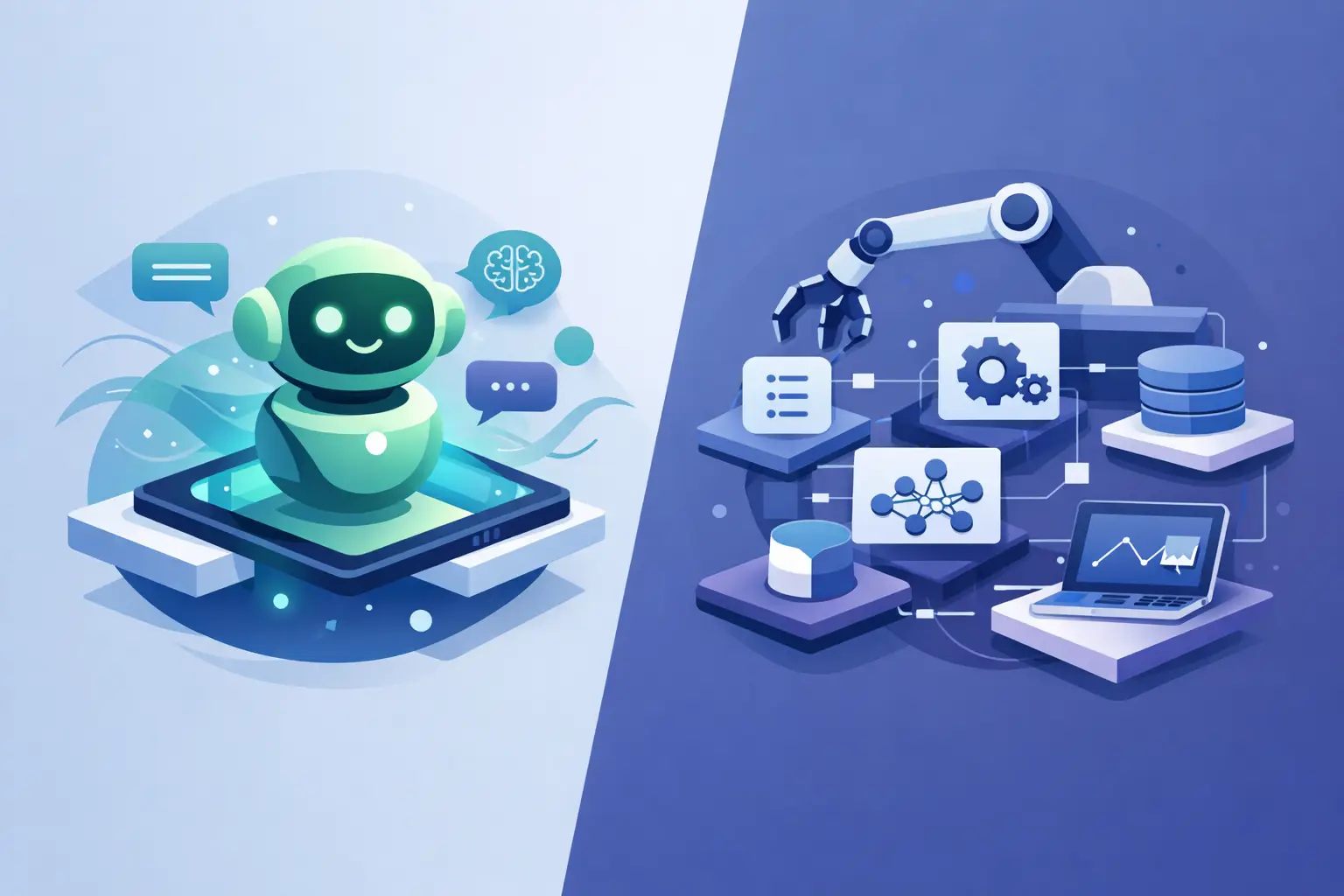
ChatGPT is useful at the edge of work, where people need help thinking, drafting and interpreting. Custom AI workflows are useful in the spine of the business, where repeatable tasks need to move reliably from one step to the next.
A sales team might use ChatGPT to improve proposal wording, while a custom workflow handles lead intake, qualification and follow-up reminders. An operations manager might use ChatGPT to turn rough notes into a cleaner process document, while a custom workflow handles job updates, internal notifications and client reporting. These are different uses with different returns.
The mistake is trying to force one tool to do both jobs.
How to decide what your business needs
Start by looking at friction, not features. Where does work get delayed? Where do staff repeat the same admin? Where do handovers break down? Where are managers chasing updates that should already be visible?
Then separate tasks into two groups. The first group needs human judgement, flexible thinking and quick support. These are often good candidates for ChatGPT. The second group follows a repeatable path, even if there are a few exceptions. These are stronger candidates for custom workflows.
Be honest about process maturity as well. If your workflow is unclear, AI will not fix that on its own. You may need to simplify the process before automating it. That is not a setback. It is usually where the real value starts.
For UK SMEs, the practical route is usually to begin with one or two operational bottlenecks that have obvious commercial impact. Fixing proposal turnaround, lead handling, inbox triage or reporting admin will teach you more than a dozen speculative AI experiments.
At AI For Businesses, this is typically where useful implementation work starts - not with a giant transformation promise, but with getting one important workflow working properly and building from there.
The better question than ChatGPT versus custom AI workflow
Instead of asking which is better in general, ask which one removes the most friction in your current business. ChatGPT is often the best place to start. A custom AI workflow is often the best way to scale what works.
If you treat AI as a clever assistant only, you may save a bit of time. If you treat it as part of your operating system, you can change how the business runs. The right choice is the one that your team will actually use, your managers can rely on, and your business can own long after the first burst of enthusiasm wears off.
Written by
AI For Businesses
The team at AI For Businesses helping UK companies adopt AI in practical, build-focused ways.
Enjoyed this article?
Get more practical AI tips delivered to your inbox weekly.