Custom AI Build vs Software: Which Fits?
AI For Businesses
Custom AI build vs software - learn when to buy tools, when to build around your workflow, and how UK firms avoid waste, lock-in and delays.

You can usually spot the problem before anyone says it out loud. The team has five different tools doing bits of the same job, admin still piles up, and someone keeps asking whether the answer is "an AI tool" or "something custom". That is where the custom AI build vs software question becomes useful. Not as a tech debate, but as a business decision about speed, control, cost and whether the fix will actually match how your company works.
Most firms do not need a grand transformation plan. They need a practical way to reduce repetitive work, improve handovers, tighten delivery and stop buying software that creates more process than it removes. Sometimes that means choosing an existing product. Sometimes it means building a custom AI-enabled workflow on top of the tools you already use. The right answer depends less on what is possible and more on what needs to happen every week in the business.
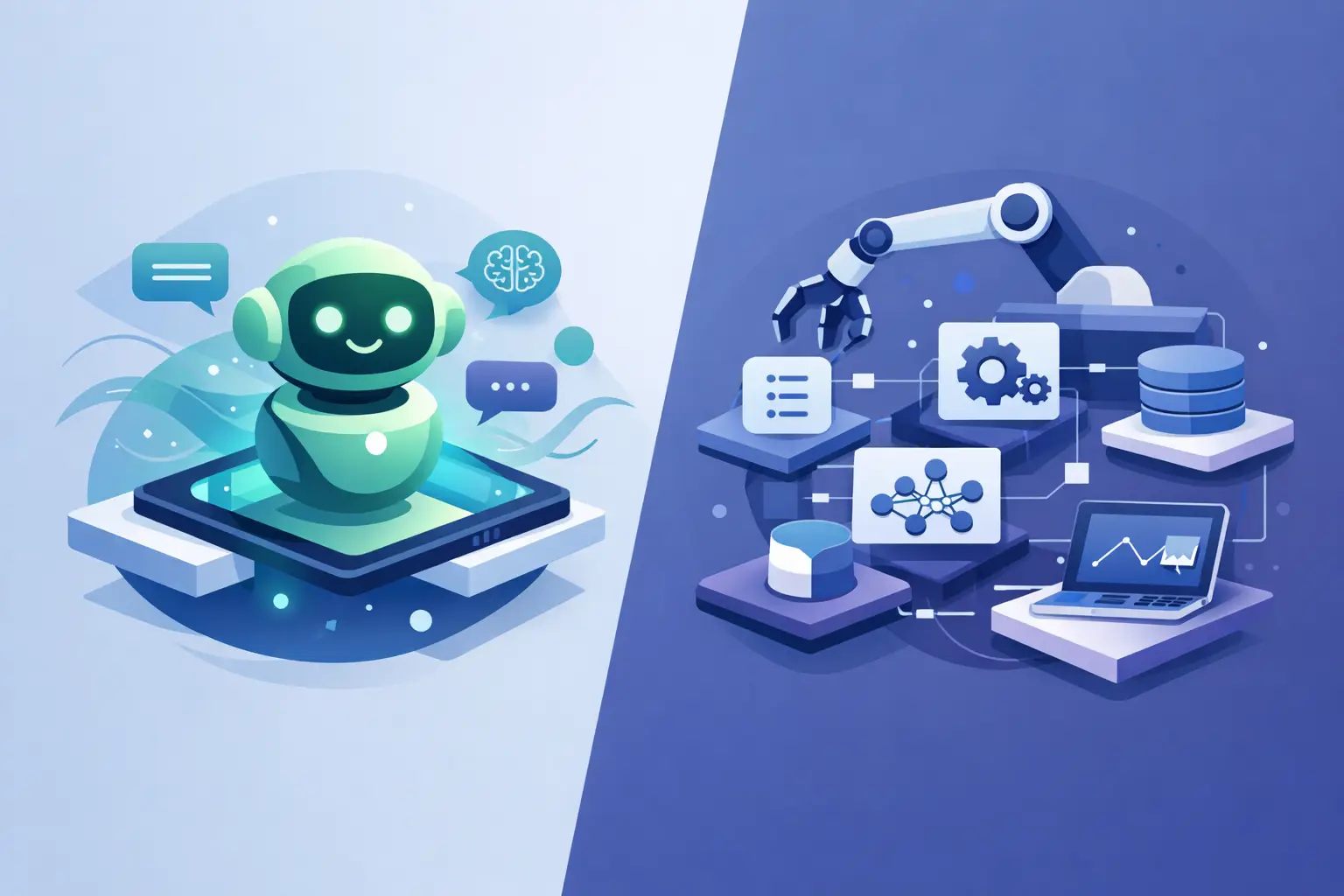
Custom AI build vs software: the real difference
Software is bought. A custom AI build is designed around your operation.
Off-the-shelf software gives you a ready-made system. It can be quick to adopt, easier to budget for and perfectly sensible if your need is common. If you want meeting transcription, email drafting, document search or a basic chatbot, there are plenty of capable tools available. In the right context, buying is the fastest route to value.
A custom AI build is different. Instead of asking your team to adapt to a product, you shape the workflow around the way the business already runs, or around the way it should run. That might mean pulling data from your inbox, CRM and forms, classifying requests, drafting replies, creating tasks, updating records and giving a manager a clear daily view of what needs attention. The AI is only one part of it. The real value is in the system around it.
This is where many businesses get caught out. They think they are choosing between "AI" and "non-AI". They are not. They are choosing between a standard product with standard rules and a tailored setup that reflects their processes, roles and edge cases.
When software is the better choice
There is no prize for building something custom if a sensible product already solves the problem.
Software tends to win when your process is fairly standard, the tool category is mature and the cost of adapting your team is lower than the cost of tailoring a system. If you need note-taking, simple automation, scheduling support or a shared knowledge base, buying software is often the sensible move. It is also usually the right starting point if the business is still figuring out what good looks like.
That matters because many teams try to customise too early. If your internal process is messy, undocumented or still changing every month, a custom build can lock confusion into code. In those cases, software can act as a forcing function. It gives you structure, helps you test behaviour and shows where the real friction sits.
Software is also better if speed matters more than precision. If you need something live this month and the process is not mission-critical, a good-enough tool with clear boundaries may be all you need. Not every inefficiency deserves a build.
When a custom AI build makes more sense
A custom AI build starts to make sense when the business is losing time because the workflow does not fit standard software.
That usually shows up in one of three ways. First, the work crosses multiple systems and nobody has a clean view of what is happening. Second, the process depends on business-specific rules, approvals or judgement calls that off-the-shelf tools cannot handle well. Third, your team is paying for several products, but still relying on manual copying, checking and chasing.
Take a service business handling inbound enquiries, proposals and project setup. A standard CRM may store contact data well enough, but it may not qualify leads in your language, route work based on capacity, generate tailored drafts, brief delivery teams and surface risks to a manager without heavy manual effort. That is where a custom build earns its keep. It can stitch the flow together so work actually moves.
The same applies when ownership matters. Many firms do not want to be trapped inside one vendor's way of working, especially if pricing changes, features shift or the product roadmap moves away from what they need. A well-structured custom setup, built on the client's own accounts, gives more control. That does not remove dependency entirely, but it usually reduces it.
Cost is not just the monthly subscription
This is where the custom AI build vs software decision often gets distorted. People compare a monthly software price with a build quote and assume software is cheaper.
Sometimes it is. Often it only looks cheaper at the start.
Software costs are not just licences. They include onboarding time, workflow compromises, duplicate tools, failed adoption, workaround labour and the cost of managers patching gaps between systems. If three team members spend several hours each week moving information from one place to another because your stack does not quite fit, that is a real operating cost.
Custom builds have the opposite profile. They tend to cost more up front, but if they remove repeated admin, cut software waste and improve delivery visibility, they can become cheaper over time. The key point is not that custom is always better value. It is that the comparison should be based on total cost of operation, not sticker price.
That also means being realistic about scale. A small business does not need an enterprise-grade platform to automate common tasks. In many cases, the most effective build is a lightweight system using existing tools, well-designed prompts, practical automations and a clear handoff between AI and humans.
The hidden issue is workflow clarity
The best technology choice usually follows a more boring question: do you actually understand the process you are trying to improve?
Businesses often ask for software when what they really need is workflow design. They know the symptoms - delays, inbox clutter, missed follow-ups, inconsistent delivery - but not the underlying path the work takes. Without that clarity, buying software becomes guesswork and building custom becomes expensive guesswork.
A useful implementation starts by mapping the current state. Where does work enter? Who touches it? What decisions get made? What information is repeated? Where do delays happen? Which steps require human review and which ones are simply admin?
Once that is clear, the decision gets easier. If the process is mostly standard and a product covers it, buy the product. If the process is central to your business and full of company-specific logic, build around it.
How to decide without overcomplicating it
You do not need a technical background to make a good call here. You need a practical filter.
Start with the job that is costing the team the most time or causing the most inconsistency. Then ask four simple questions. Is this a standard business problem with strong software options already available? Does the workflow span several tools or teams? Are we changing our process to suit software, when the process itself is commercially important? And if we improve this, do we save meaningful time every month?
If the answers point towards a common need with low complexity, software is probably enough. If they point towards fragmentation, repeated manual effort and business-specific logic, a custom build is more likely to hold up.
There is also a middle ground, and for many SMEs that is the best route. Use software where categories are mature, then add a custom layer where your operation needs something more precise. This avoids the false choice between buying everything and building everything.
That blended approach is often the most commercially sensible. You keep the speed and reliability of proven tools, while tailoring the parts that actually create friction. For a lot of UK firms, that means fewer subscriptions, clearer ownership and better management information without taking on a giant development project.
Why this matters more now
AI has made it easier to generate output, but that is not the same as running a better business. Plenty of teams can now draft content, summarise calls or answer simple questions. The bottleneck has shifted. It is no longer access to AI. It is whether the business has a usable operating system around the work.
That is why the custom AI build vs software conversation matters. It forces a more useful question: are we buying another tool, or are we improving the way the company functions?
Good decisions here are rarely flashy. They look like cleaner handovers, faster response times, less chasing, fewer missed tasks and managers who can see what is happening without asking five people for updates. That is what practical AI should lead to.
If you are weighing it up, resist the urge to start with features. Start with friction. The clearest answer usually sits there. And once you fix the right operational problem, the technology choice becomes much less mysterious.
Written by
AI For Businesses
The team at AI For Businesses helping UK companies adopt AI in practical, build-focused ways.
Enjoyed this article?
Get more practical AI tips delivered to your inbox weekly.