AI Consultant vs AI Agency: Which Fits?
AI For Businesses
AI consultant vs AI agency: learn the real difference, costs, trade-offs and which model suits your business, team, budget and goals best.
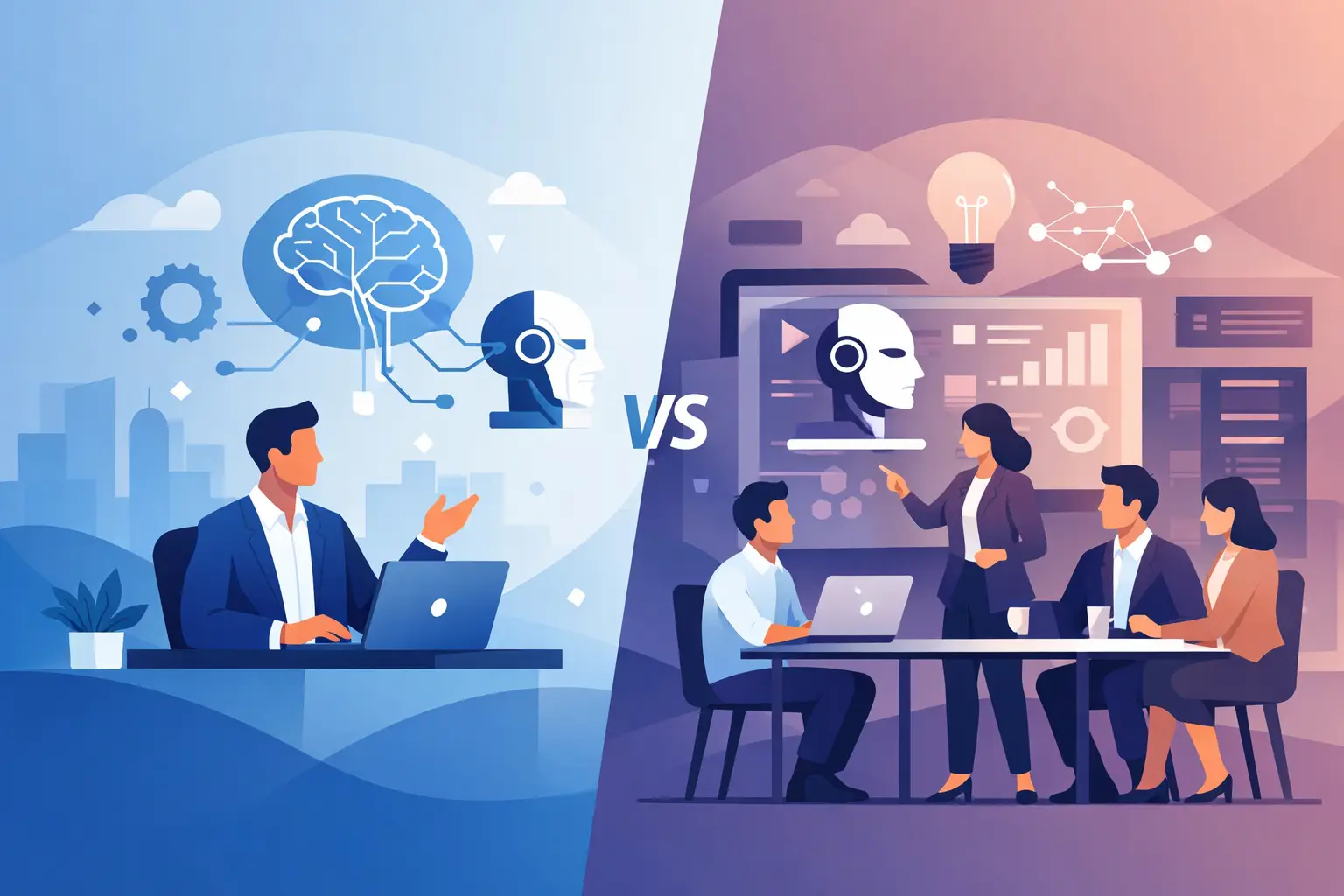
If you are comparing an AI consultant vs AI agency, you are probably already past the curiosity stage. You do not need another article telling you AI is the future. You need to know who is actually going to help you fix the backlog, reduce admin, sort your systems and build something your team will use.
That decision matters because the wrong model creates a familiar mess. You pay for strategy and get no implementation. Or you buy implementation without enough business context, and end up with tools that look clever but do not fit how your company runs. For most small and mid-sized businesses, the real question is not which option sounds more impressive. It is which one gives you clarity, momentum and ownership.
AI consultant vs AI agency: the real difference
An AI consultant is usually a smaller, more direct engagement. Often that means one person or a small specialist team working closely with you to understand how the business operates, identify the best use cases, recommend tools and help implement them in a way that fits your workflows.
An AI agency usually brings a broader delivery model. That can include strategists, project managers, developers, designers and automation specialists under one roof. Agencies are often set up to handle larger scopes, bigger delivery teams and more formal project structures.
Neither model is automatically better. The difference is in how the work gets done, how much context is retained and what level of support you actually need.
A consultant tends to win on closeness, flexibility and commercial focus. You are more likely to speak to the same person throughout. Decisions move faster. Advice is often shaped around operational reality rather than what fits an internal agency process.
An agency tends to win when there is a genuinely larger delivery requirement. If you need multiple workstreams running at once, specialist technical resources or a more traditional outsourced team, an agency may be the better fit.
When an AI consultant makes more sense
For many SMEs, a consultant is the more practical choice because the problem is not a lack of ideas. It is a lack of time, structure and follow-through.
If your business has tool sprawl, inconsistent processes or too many manual tasks sitting across different teams, you usually need someone to audit what is happening, strip away the noise and build a sensible plan. That often suits a consultant-led model better than a larger agency engagement.
The same applies if you want AI embedded into existing operations rather than spun off as a separate innovation project. Most businesses do not need a grand transformation programme on day one. They need better quoting, cleaner handovers, faster content workflows, improved reporting, smoother customer service and fewer repetitive tasks. That work benefits from close collaboration and a steady rhythm.
A consultant also tends to be a better fit if you want to keep ownership. Good consultants build on your accounts, inside your stack, with your team involved. That reduces dependency and makes it easier to maintain what has been built.
This is especially useful for owner-led businesses, agencies, service firms and growing operations teams. They need practical changes that save time now, not six weeks of workshops followed by a slide deck.
The trade-off with a consultant
The main limitation is bandwidth. A solo consultant or small consultancy can only handle so much at once. If your project needs a full development squad, complex product build or heavy custom engineering across several departments, one consultant may struggle unless they have trusted partners.
There is also more variation in quality. Some consultants are deeply practical. Others are mostly advisers. If you hire one, you need to know whether they stop at recommendations or stay to implement.
When an AI agency makes more sense
An agency can be the right choice when scope is large, timelines are tight and the business needs multiple disciplines at once.
For example, if you are rolling out AI across several teams, integrating with existing systems, developing custom applications and managing change across the business, an agency may offer the delivery capacity to support that properly. You may need developers, process designers, testers and project management all at the same time.
Agencies can also suit companies that prefer formal structures. If your procurement process requires a larger supplier, fixed project governance and documented handovers, an agency model can feel safer.
Some businesses also value the breadth of service. If you want strategy, implementation, training and technical support packaged into one supplier relationship, an agency may be easier to buy from internally.
The trade-off with an agency
The risk is distance. Larger teams can mean more handovers, more account management and less direct access to the person doing the thinking. For smaller businesses, that can create unnecessary complexity.
Cost can also climb quickly. You may be paying for layers of process that make sense for enterprise clients but add little value for a 20-person company trying to improve operations. And if the agency builds too much around its own systems, you can end up dependent on them for routine changes.
That does not mean agencies are poor value. It means you should be honest about whether you need agency-scale delivery or simply competent implementation with clear commercial judgement.
Cost, speed and practicality
Cost is one of the biggest factors in the AI consultant vs AI agency decision, but headline pricing can mislead.
A consultant may appear cheaper because overheads are lower. In many cases, that is true. But the better way to think about cost is total useful output. If a consultant quickly identifies the right workflows, removes unnecessary tools and helps your team adopt workable systems, the return can be strong even on a modest monthly retainer.
An agency may cost more, but if your project genuinely needs several specialists working in parallel, the higher fee can be justified. The mistake is paying agency rates for consultant-sized work.
Speed matters too. Consultants often move faster in the early stages because communication is direct and the scope can evolve without layers of approval. Agencies may be slower to start but stronger at handling bigger delivery once the project is established.
For many SMEs, the practical sweet spot is not a one-off project at all. It is ongoing support that combines advice, implementation and iteration over time. AI works best when it is treated as an operational improvement programme, not a big reveal.
What to ask before you choose
The best supplier conversations are not about impressive terminology. They are about delivery.
Ask who will actually do the work. Ask whether recommendations will be implemented or just documented. Ask whether builds will sit in your own accounts. Ask what happens after the first phase is live. Ask how they measure whether the work is saving time or improving output.
You should also ask how they deal with existing software. A good partner should help reduce software waste, not add more tools for the sake of it. If every answer leads to another subscription, be careful.
It is worth asking about pace as well. Many businesses do not need a huge programme. They need a steady monthly rhythm that gets useful things shipped, reviewed and improved. That is often where a practical consultant-led approach stands out.
Which option is right for your business?
If you run a small or mid-sized business and need AI applied to day-to-day operations, a consultant is often the better fit. You get closer collaboration, clearer accountability and advice shaped around the reality of your business rather than a standard delivery model.
If your requirements are broader, more technical and involve several concurrent workstreams, an agency may be the right call. The extra structure and resourcing can help if the scope truly demands it.
What matters most is not the label. It is whether the partner can understand your business, simplify the path forward and help you build systems that your team can actually own and use.
That is why many firms choose a middle ground - practical consulting with implementation built in. Not just ideas. Not just outsourced delivery. A working relationship that starts with workflow clarity, moves into real builds and continues long enough to make the changes stick. That is the model AI For Businesses is built around, because most companies do not need theatre. They need useful progress.
If you are still unsure, start with the problem rather than the provider type. Look at where work is getting stuck, where time is being lost and where decisions are slowed down by messy systems. The right partner should make that picture clearer within the first conversation. If they cannot, they are probably not the right fit.
Written by
AI For Businesses
The team at AI For Businesses helping UK companies adopt AI in practical, build-focused ways.
Enjoyed this article?
Get more practical AI tips delivered to your inbox weekly.