In House AI Versus Consultant: Which Fits?
AI For Businesses
In house AI versus consultant: learn which model suits your business, budget and team capacity, and where each option delivers the best result.

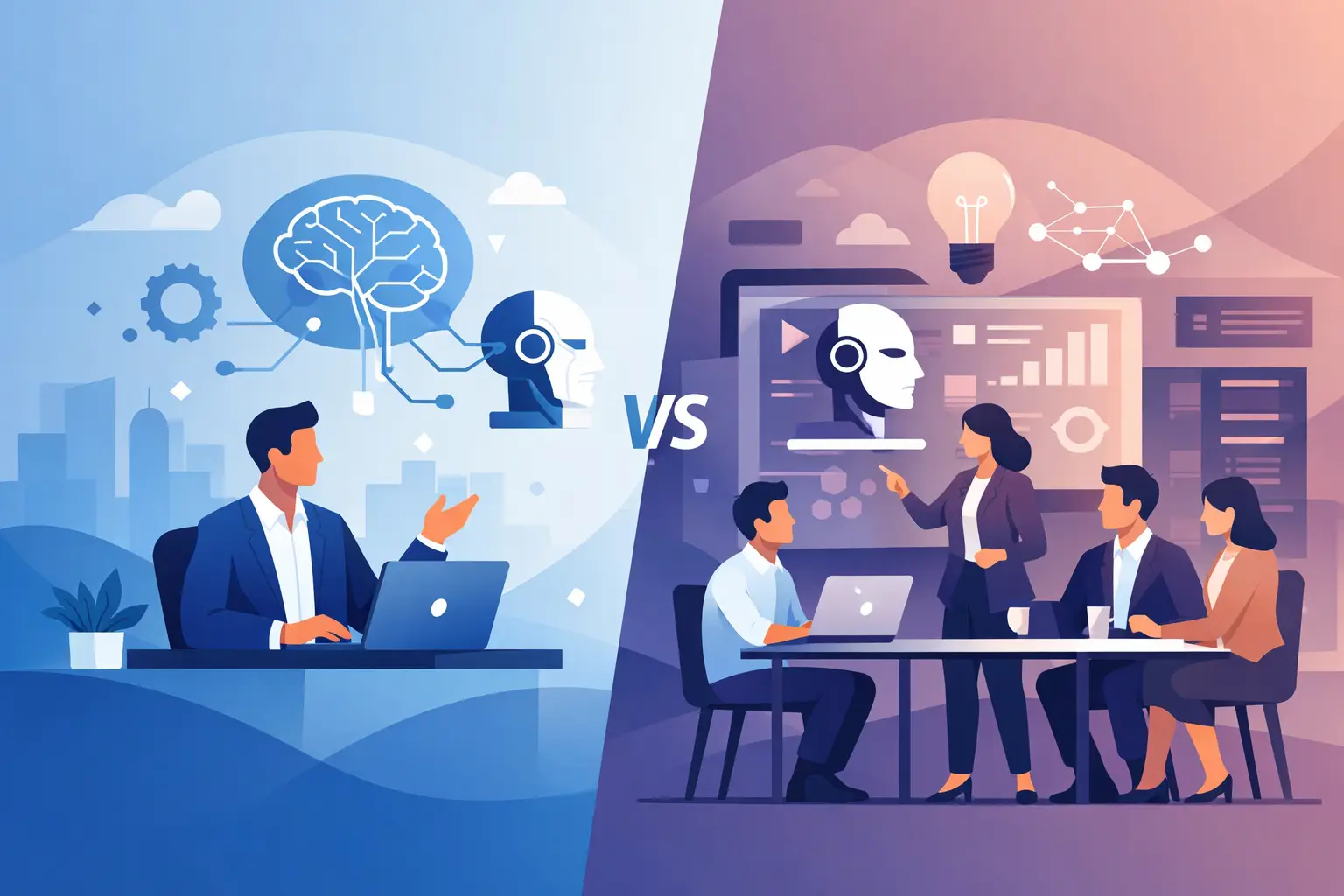
When a business owner asks about in-house AI versus consultant, they are rarely asking a theoretical question. They are usually staring at a backlog of admin, a team stretched across too many systems, and a growing sense that AI should be helping by now. The real decision is not who knows more about AI. It is who can get useful systems running, with the least waste, in the context of your actual business.
For most small and mid-sized firms, this is not a simple either-or choice. It depends on speed, budget, internal capability, and how much change your team can absorb without dropping the day job. There are cases where hiring in-house makes perfect sense. There are also many where bringing in a consultant is the quicker, safer, and more commercially sensible route.
In-house AI versus consultant: what are you really choosing?
At face value, the choice looks straightforward. In-house AI means employing someone internally to lead tool selection, workflow redesign, automation, prompting standards, training, governance, and often a fair bit of expectation management. A consultant means paying an external specialist to assess the business, identify opportunities, build solutions, and support rollout.
But that framing misses the practical difference. In reality, you are choosing between building capability and buying momentum.
An internal hire can become part of the fabric of the business. They sit in team meetings, understand political realities, and can keep improving systems over time. That is valuable. The problem is that many smaller businesses hire too early, before they know what role they actually need. They advertise for an “AI person” when what they really need is part operations lead, part systems thinker, part trainer, and part builder. That combination is hard to find and rarely cheap.
A consultant, by contrast, is useful when you need clarity fast. A good one does not just recommend tools. They look at how work moves through the business, where time is being lost, what can be standardised, and what should not be automated at all. The benefit is focus. The risk is dependency if the work is not built in a way your team can own.
When in-house AI makes sense
If your business is already large enough to support a dedicated systems, data, or AI function, an internal hire can be the right long-term move. This tends to work best when there is enough volume and complexity to justify an ongoing role, not just a burst of implementation.
For example, if you run a multi-site operation with recurring reporting demands, complex customer service workflows, sales teams using inconsistent processes, and a steady pipeline of internal improvement projects, then having someone embedded internally can create real compounding value. They can set standards, train managers, refine prompts, maintain automations, and keep pushing adoption after the initial excitement wears off.
It also makes sense when AI has become core to your delivery model rather than just your back office. If your commercial model depends on proprietary workflows, specialist data handling, or product features shaped by AI, internal capability matters more. In those situations, it may be risky to leave too much knowledge outside the business.
The difficulty is timing. A lot of firms try to hire in-house before they have enough clarity to use that person properly. The hire then spends months dealing with scattered requests, trialling too many tools, and trying to educate the business while also proving return on investment. That is a tough brief.
When a consultant is the better option
For many SMEs, a consultant is the more practical starting point because the business does not need a permanent AI lead yet. It needs decisions, systems, and progress.
That is especially true when the leadership team knows AI matters but lacks the time to explore it properly. In those cases, internal ownership is weak not because people do not care, but because they are already busy running operations. A consultant can step in, structure the work, prioritise opportunities, and get early wins in place without adding another full salary.
This approach also suits businesses that are suffering from tool overload. They may already be paying for software they barely use, with manual handoffs between inboxes, spreadsheets, CRMs and project tools. An experienced consultant can often reduce that mess rather than adding to it.
The best consulting work is not a slide deck and a handover note. It is practical implementation on your accounts, in your workflows, with enough support for the team to keep using what has been built. That difference matters. Advice without delivery often becomes another postponed project.
Cost is not just salary versus fees
The in-house AI versus consultant decision often gets reduced to cost, but most businesses compare the wrong numbers.
An internal hire is not just salary. It is recruitment time, employer costs, management overhead, training, software access, and the risk of hiring the wrong profile. If that person leaves after nine months, much of the capability may leave with them. Even a strong hire needs direction, and many owners underestimate the amount of leadership required to make the role effective.
A consultant is not just a fee either. You are paying for experience, pace, pattern recognition, and delivery capacity. The right consultant can compress six months of muddled experimentation into six weeks of useful action. That has commercial value, especially if your team is stuck or if delays are already costing money.
Where consultants become poor value is when the scope is vague, the advice is generic, or the business expects transformation without internal engagement. Outside support still needs internal participation. Someone in the company has to make decisions, provide access, and help embed changes.
Capability, speed, and ownership
This is where the trade-offs become clearer.
If speed matters most, consultants usually win. They have seen similar operational problems before and can move quickly from audit to design to implementation. If deep internal ownership matters most over several years, in-house usually wins, provided you can recruit well and give that person the right brief.
If your team is non-technical, an external partner can also reduce risk. They can translate AI into plain operational terms and stop the business wasting time on shiny tools that do not fit. On the other hand, if your company already has strong internal operations and systems leadership, an in-house AI lead may slot in well and build from that base.
Ownership is often misunderstood here. Some firms assume that using a consultant means giving up control. It should not. Done properly, consultant-led implementation should leave the business with documented workflows, working systems on its own platforms, and a team that understands what has been built. That is very different from being trapped in someone else’s stack.
A hybrid model is often the sensible answer
For many businesses, the smartest route is not choosing one side forever. It is using each model at the right stage.
A consultant can help define priorities, clean up workflows, select the right tools, and build the first practical systems. Once the business has traction and knows where AI creates value, it becomes much easier to decide whether to hire internally. At that point, you are not recruiting based on hype. You are recruiting against a real operating model.
This hybrid approach works well because it reduces guesswork. Instead of hiring an in-house lead to work out the strategy from scratch, you bring them into a business where standards, opportunities and systems already exist. That person can then focus on adoption, maintenance and further development rather than firefighting basic confusion.
It is one of the reasons firms such as AI For Businesses focus on steady implementation and support rather than one-off advice. Businesses do not usually need more theory. They need enough external help to get organised, build useful things, and keep moving without losing ownership.
How to decide what fits your business
A simple test helps. If your business cannot yet clearly answer what should be automated, which workflows matter most, who will own change internally, and how success will be measured, you are probably not ready for a dedicated in-house AI hire. You need structure first.
If, however, you already have a clear roadmap, enough project volume, leadership support, and the budget to retain someone good for the long term, hiring internally may be the right move.
There is no badge for doing it all yourself. There is also no virtue in outsourcing forever. The sensible choice is the one that gets useful systems into the business, helps the team adopt them, and leaves you with more control rather than less.
The best AI setup is rarely the most fashionable one. It is the one that fits the size of your business, the capacity of your team, and the pace at which you actually need to change. Start there, and the decision becomes much easier.
Written by
AI For Businesses
The team at AI For Businesses helping UK companies adopt AI in practical, build-focused ways.
Enjoyed this article?
Get more practical AI tips delivered to your inbox weekly.