AI Consultant for Small Business: What to Expect
AI For Businesses
Need an ai consultant for small business? Learn what good support looks like, what to avoid, and how to get practical results fast.
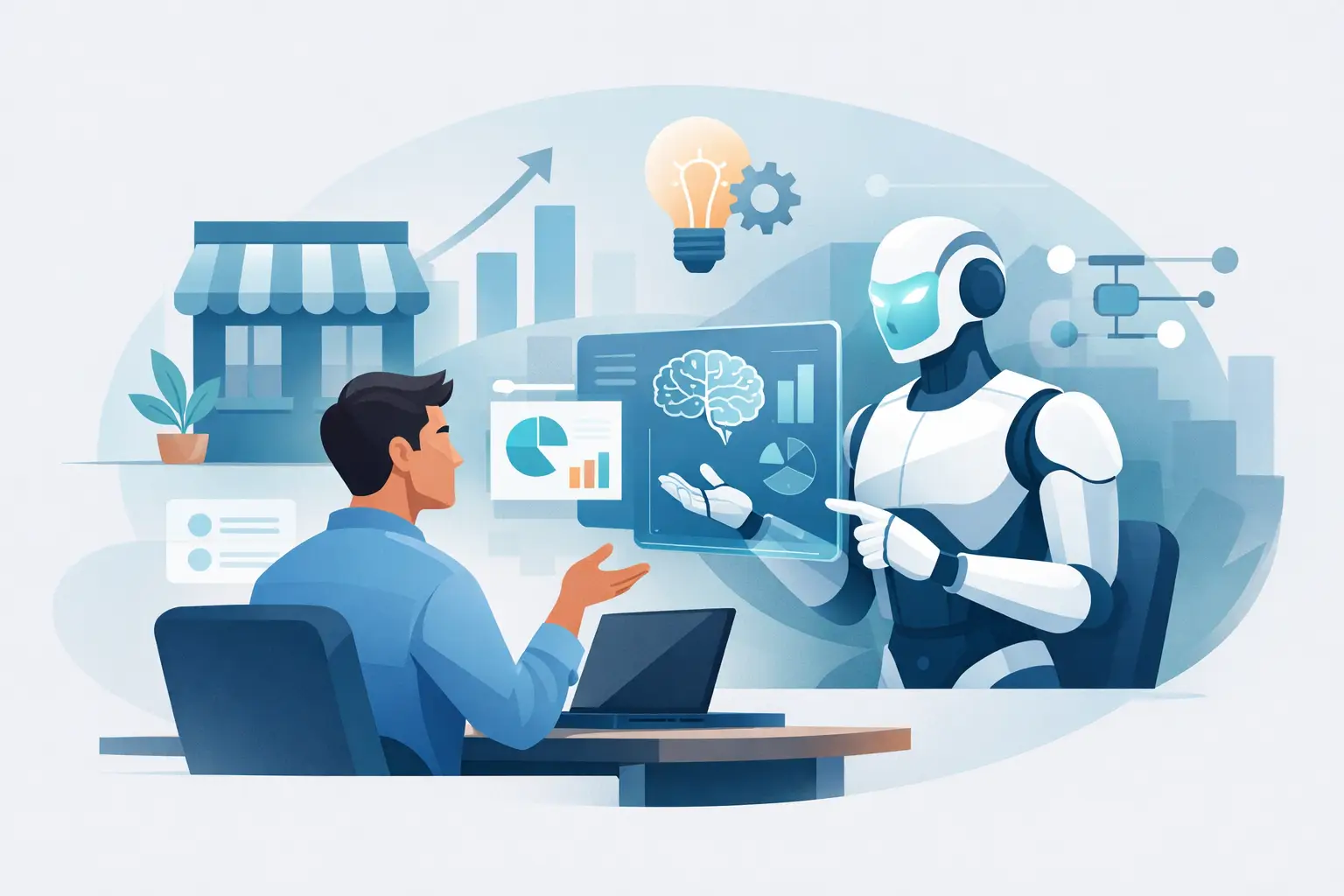
If you are looking for an ai consultant for small business, you probably do not need another talk about the future. You need someone who can look at how work actually moves through your business, spot where time is being lost, and help you put useful systems in place without creating a mess.
That is the real gap for most smaller firms. The issue is rarely access to AI tools. There are plenty of those already. The problem is deciding what to use, where to use it, and how to make it stick across a busy team that still has client work to deliver.
What an ai consultant for small business should actually do
A good consultant should start with the business, not the software. That means understanding your workflows, your current tools, your team capacity, and the points where work slows down, gets duplicated, or depends too heavily on one person.
In practice, that might mean reviewing how enquiries are handled, how proposals are written, how delivery notes are captured, how reporting is produced, or how managers keep track of work in progress. AI is useful when it removes friction from those day-to-day jobs. It is much less useful when it sits in a separate playground nobody needs.
The right support usually covers four areas. First, clarity on where AI can save time or improve consistency. Second, tool selection based on your existing stack rather than a complete reset. Third, implementation - meaning prompts, workflows, automations, templates, or custom builds that staff can actually use. Fourth, ongoing adjustment, because the first version is rarely the final one.
If all you get is a strategy deck, you have not really bought implementation. For a small business, that is where most AI projects fail. The ideas sound sensible, but no one has the time to turn them into working systems.
Why small businesses struggle to implement AI on their own
Most owners and managers are not short on information. They are short on time, internal capability, and confidence that they are choosing the right path.
A small business often ends up in one of three positions. The first is tool overload - several subscriptions, lots of testing, no standard way of working. The second is delay - everyone agrees AI matters, but nobody owns the rollout. The third is overbuying - paying for software or development work before the business has defined the workflow properly.
This is why external help can make sense. Not because AI is too complicated to understand, but because implementation requires structure. Someone needs to audit the current setup, make decisions, build the first version, train the team, and keep improving it over time.
That is especially true in service businesses, agencies, consultancies, and operationally stretched firms where the founders are still close to delivery. In those businesses, every inefficiency shows up quickly in missed follow-ups, admin backlog, slower turnaround, or poor handover between people.
What good AI consulting looks like in practice
Good consulting is usually steady rather than dramatic. It is not a big reveal. It is a sequence of practical changes that make work easier.
For example, a consultant might help a small sales team reduce time spent preparing proposals by building a structured drafting process using the firm’s own templates and language. For an operations team, the priority might be extracting actions from meetings, updating records, and producing cleaner handovers. For a solo consultant, it could be turning scattered notes, voice memos, and client materials into organised outputs without adding more admin.
The detail matters. A useful system fits the business as it already runs, while improving it. That means using your own accounts where possible, keeping ownership with you, and avoiding a setup that only works if the consultant stays forever.
There should also be a clear monthly rhythm. Review what is happening, prioritise the next improvements, build them, test them, and train the people using them. That is how AI becomes part of operations rather than a side experiment.
How to assess an ai consultant for small business
The first thing to look for is whether they talk about business processes before they talk about models and tools. If the conversation jumps straight to software without understanding your bottlenecks, that is a warning sign.
The second is whether they can explain their work in plain English. Small business owners do not need jargon. They need to know what will change, how long it will take, what it will cost, and who will use it.
The third is whether they build with ownership in mind. You should be able to access the tools, prompts, automations, and documentation yourself. If the setup relies on hidden systems or locked-down environments, you may end up dependent on a supplier for basic changes.
The fourth is whether they focus on measurable outcomes. Time saved is useful. So is reduced rework, faster turnaround, fewer missed tasks, cleaner reporting, or better management visibility. If nobody can describe the before and after, the project is likely too vague.
It also helps to ask how they handle trade-offs. Not every process should be automated. Not every team is ready for the same level of change. A sensible consultant will tell you where a simple template beats a complicated workflow, or where a human review step still matters.
What to avoid
Be careful with anyone selling AI as a full business transformation before they have fixed the basics. If your files are disorganised, your processes are inconsistent, and your team is already stretched, adding more tools can make things worse.
You should also be cautious about one-off workshops with no implementation plan. Workshops can be useful, but only if they lead to action. On their own, they often create a short burst of enthusiasm followed by no real change.
Another common problem is buying custom software too early. Sometimes a bespoke build is the right move, but many small firms can get strong results from better use of existing platforms, supported by a few lightweight custom elements where needed. The expensive route is not always the effective one.
Finally, avoid hype-led promises. No consultant can responsibly guarantee that AI will replace whole teams, remove all admin, or fix broken management. What it can do is improve specific workflows, reduce wasted effort, and help your people spend more time on work that needs judgement.
The best projects start small, then compound
For small businesses, the smartest AI work usually starts with one or two processes that are painful, repetitive, and easy to measure. That could be lead handling, reporting, internal knowledge management, proposal drafting, customer support triage, or task follow-up.
Once those systems are working, the business gains confidence. Staff can see what good use looks like. Managers can judge the value properly. Then it becomes easier to expand into other areas without creating confusion.
This matters because adoption is often the real challenge. A technically clever setup is worthless if nobody uses it. The best projects are the ones that feel immediately useful. They save time in week one, not just in theory.
That is also why ongoing support tends to outperform one-off advice. Businesses change. Staff change. Tools change. Priorities shift. AI systems need maintenance and refinement just like any other operational process. A monthly implementation model is often a better fit than a big upfront consultancy exercise followed by silence.
Is hiring an AI consultant worth it?
It depends on the level of friction in your business and whether anyone internally can lead the work. If you already have a capable operations lead with time to spare, outside support may only be needed for specialist input. If your team is stretched, your systems are patchy, and AI has stalled at the testing stage, bringing in a consultant can shorten the path considerably.
The value comes from making better decisions earlier, avoiding wasted spend, and getting working systems live faster. For many firms, that matters more than finding the newest tool.
A company like AI For Businesses is built around that practical model - structured support, implementation inside the client’s own workflows, and ongoing momentum rather than a stack of ideas left on a slide.
If you are choosing an ai consultant for small business, look for someone who can make the work clearer, not more complicated. The right partner should leave you with better systems, stronger ownership, and a business that runs with less drag every month.
Written by
AI For Businesses
The team at AI For Businesses helping UK companies adopt AI in practical, build-focused ways.
Enjoyed this article?
Get more practical AI tips delivered to your inbox weekly.