Business Process AI Roadmap for SMEs
AI For Businesses
A practical business process AI roadmap for UK SMEs - how to prioritise workflows, choose tools, reduce waste and implement AI properly.

Most AI projects go wrong before any tool is switched on. The problem is not usually the software. It is that the business never had a clear business process AI roadmap in the first place. Teams buy a few subscriptions, test a chatbot, automate one task, then wonder why nothing really changes.
If you run a small or mid-sized business, the answer is not to do more AI. It is to apply it to the right processes, in the right order, with clear ownership. A good roadmap gives you that structure. It helps you decide what to fix first, what to ignore for now, and where AI will actually save time or improve service rather than create another layer of admin.
What a business process AI roadmap actually is
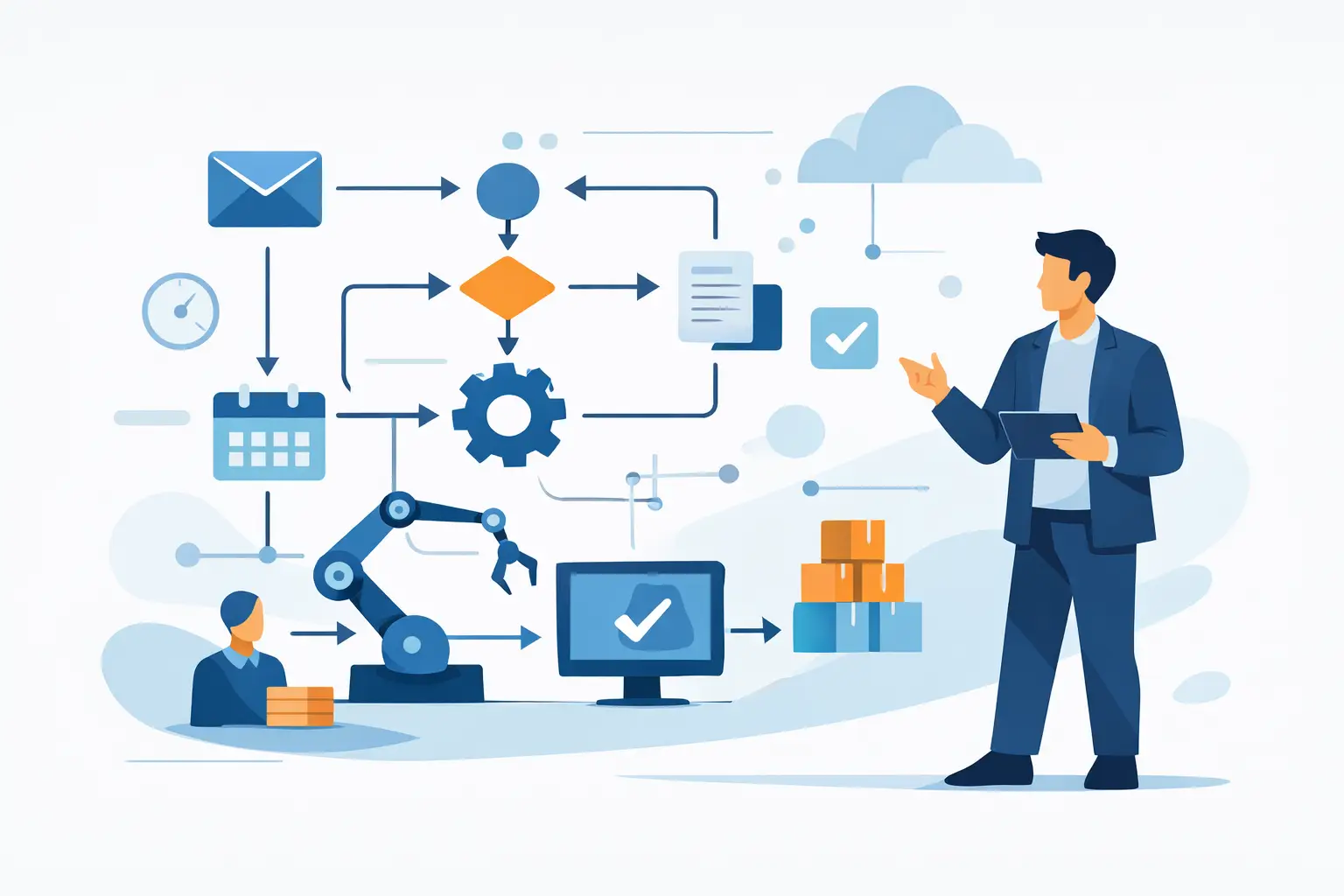
A business process AI roadmap is a practical plan for improving how work gets done using AI where it genuinely helps. It is not a strategy deck full of trends, and it is not a shopping list of tools. It connects your operational problems to specific changes in workflow, systems and team responsibilities.
That distinction matters. Most businesses do not need an "AI strategy" in the abstract. They need fewer bottlenecks in delivery, faster reporting, less manual chasing, better handovers, and more consistent admin. AI only becomes useful when it is attached to those outcomes.
A proper roadmap usually answers five questions. Which processes are slow, repetitive or error-prone? Which of those matter commercially? What data or inputs are already available? What tools fit your current setup? And who will maintain the system once it is live?
Start with workflow pain, not software demos
The best place to start is with the work that keeps irritating people. Look at the repeat tasks that eat hours each week, the steps that rely too heavily on one person, and the admin that delays decisions.
For most SMEs, that means processes like lead handling, proposal drafting, meeting follow-up, customer support triage, reporting, onboarding, recruitment admin or internal knowledge retrieval. None of this sounds glamorous, which is exactly why it is worth attention. The biggest gains often come from boring work that happens every day.
There is a trade-off here. Some processes are highly visible but low impact. Others are messy but commercially critical. A founder may be excited by AI-generated sales outreach, while the operations manager is desperate to fix the weekly reporting mess. In practice, the reporting mess may be the better first move because it is easier to control and easier to measure.
The four stages of a workable roadmap
1. Audit the current process
Before changing anything, document how the work happens now. Keep it simple. What triggers the process, what steps follow, who is involved, what systems are used, and where delays or duplication appear?
This stage often reveals that the process problem is not really an AI problem. Sometimes the issue is poor handover, duplicated data entry, or a form that nobody completed properly in the first place. AI can help after that is cleaned up, but not before.
2. Prioritise by value and readiness
Not every workflow should be touched first. A strong business process AI roadmap ranks opportunities using two filters: business value and implementation readiness.
High-value, high-readiness workflows make the best starting point. These are tasks with clear repetition, enough usable data, a defined owner and a measurable outcome. Think of automating post-meeting notes into action lists, drafting routine client updates, classifying inbound enquiries, or producing first-pass reports.
High-value but low-readiness processes can wait until the underlying process is better structured. If your sales pipeline lives across inboxes, spreadsheets and people's heads, adding AI on top will not fix the underlying chaos.
3. Choose tools that fit your existing operation
Tool selection should come late, not early. The right setup depends on your team, your current systems and how much flexibility you need.
Some businesses need lightweight AI embedded into tools they already use. Others need a custom workflow that pulls data from several systems and produces a reliable output. The point is not to build something clever. It is to build something your team will actually use without adding friction.
This is also where cost discipline matters. Many firms end up paying for overlapping AI subscriptions because nobody has mapped what each tool is meant to do. A roadmap helps reduce software waste by making each tool earn its place.
4. Implement in a monthly rhythm
The businesses that get results usually work in stages. One process is scoped, built, tested, refined and documented. Then the next one follows.
That steady rhythm matters more than grand plans. It gives the team time to adapt, exposes weak points early, and avoids the common mistake of trying to redesign the whole business in one go. At AI For Businesses, this is often the difference between a system that sticks and one that gets ignored after the initial excitement wears off.
What to include in your business process AI roadmap
A roadmap does not need to be long, but it does need to be specific. For each target workflow, define the current issue, the desired outcome, the AI role, the systems involved, the owner, the timeline and the success measure.
For example, a service business might identify client onboarding as a priority. The current issue is that handovers from sales to delivery are inconsistent. The desired outcome is a complete project brief generated from call notes, proposal details and signed paperwork. The AI role is summarising and structuring information, not making final decisions. The owner is the operations lead. Success is measured by reduced onboarding time and fewer missed details.
That level of clarity stops projects drifting. It also makes it easier to spot when AI is being forced into a process where a simple checklist or form would do the job better.
Common mistakes that slow everything down
The first mistake is treating AI as a separate innovation project rather than an operational improvement project. If it sits outside the day-to-day business, it rarely lasts.
The second is choosing processes that are too complex for a first implementation. Start where the process is repetitive and the output is clear. You can tackle judgement-heavy or cross-functional workflows later.
The third is leaving ownership vague. Someone needs to be accountable for adoption, refinement and results. Without that, even a well-built workflow can become shelfware.
The fourth is ignoring governance. SMEs do not need a heavy compliance programme, but they do need sensible rules about what data is being used, who can access what, and where human review is required. This is especially relevant in the UK if you handle customer records, financial information or sensitive HR data.
Where SMEs usually see the fastest wins
The quickest wins tend to come from internal workflows where the business controls the inputs and does not need a major system change. Meeting summaries, inbox triage, document drafting, reporting support, knowledge base search, recruitment admin and customer service categorisation are common examples.
The reason these work well is simple. They are frequent, measurable and annoying enough to matter. They also help teams feel the benefit quickly, which builds confidence for larger process changes later.
That said, speed is not everything. Sometimes the right first project is not the easiest one but the one that removes a major blocker for the rest of the business. If delayed quotations are choking revenue, that may deserve attention before easier back-office improvements.
How to know if your roadmap is working
A useful roadmap should create visible operational change within the first few months. You should see time saved, fewer manual steps, better consistency or faster decision-making. If all you have gained is a nicer presentation about AI capability, something has gone off course.
It also helps to look beyond raw hours saved. Better management visibility, reduced rework, less dependence on one overstretched person, and a cleaner software stack all matter. For many businesses, those gains are more valuable than headline automation figures.
The strongest signal is behaviour. Are people actually using the new workflow? Has it become part of how the business runs? If not, the issue is usually not the technology. It is that the process was poorly chosen, badly integrated, or never properly owned.
A business process AI roadmap should make the business calmer, not more complicated. If you keep it tied to real workflows, clear priorities and practical delivery, AI stops being a vague future project and starts becoming part of how the work gets done. Start with one process that matters, get it working properly, and let momentum do the rest.
Written by
AI For Businesses
The team at AI For Businesses helping UK companies adopt AI in practical, build-focused ways.
Enjoyed this article?
Get more practical AI tips delivered to your inbox weekly.