How to Train Staff on AI at Work
AI For Businesses
Learn how to train staff on AI with a practical plan for policies, workflows and hands-on adoption that delivers real value at work.
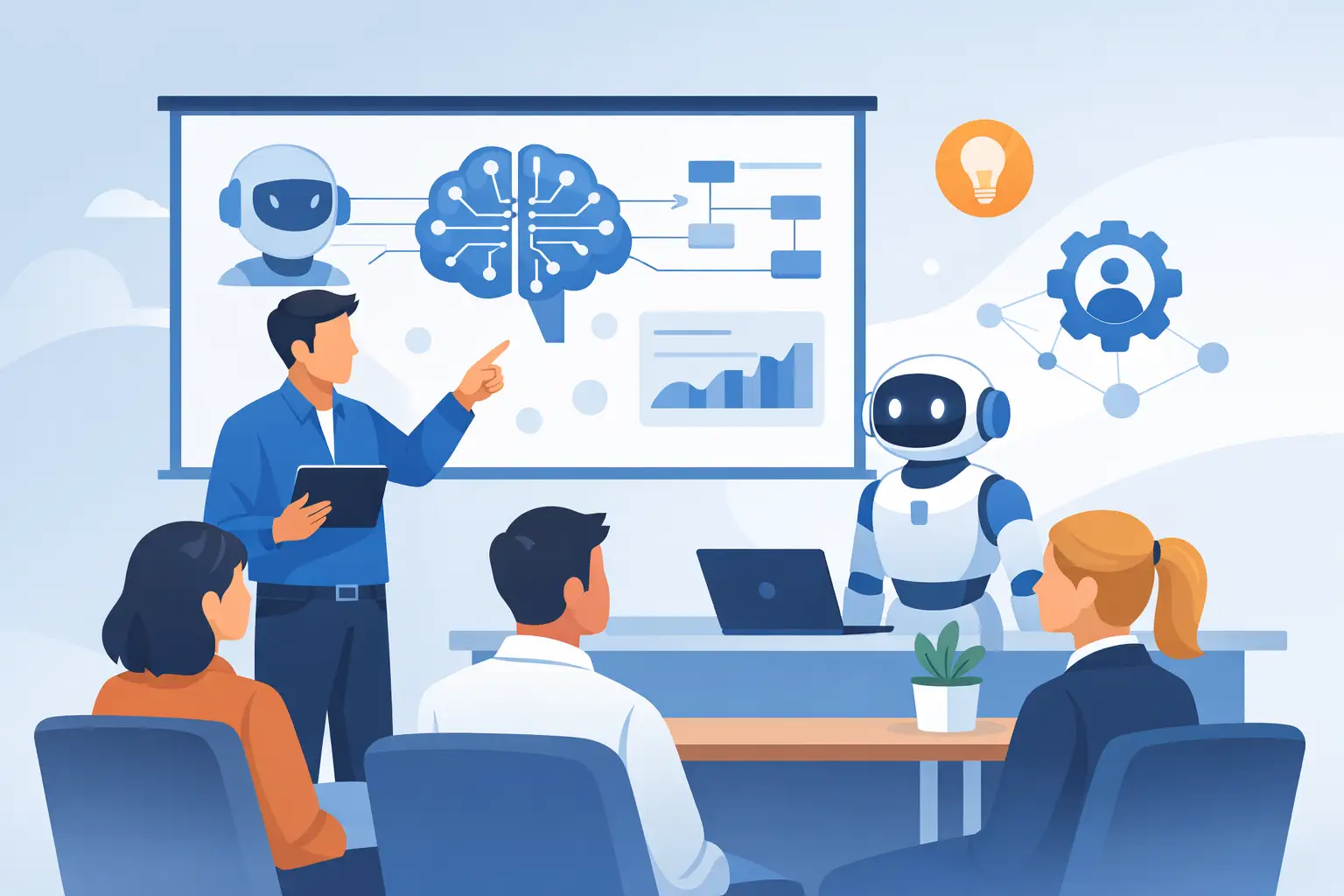
Most teams do not need another AI demo. They need clear rules, a few useful use cases, and enough confidence to use the tools without creating risk or wasting time. If you are working out how to train staff on AI, the goal is not to turn everyone into specialists. It is to help your team use AI properly in the day-to-day work that already needs doing.
That changes the shape of the training. A good programme is not built around theory, trending tools, or one big launch session. It is built around your actual workflows, your standards, and the level of judgement different roles need to apply. Done well, staff training helps people save time and make better decisions. Done badly, it creates confusion, overuse, and a growing pile of messy output that someone else has to fix.
What training staff on AI should actually achieve
The first mistake many businesses make is treating AI training as a general awareness exercise. That might be fine for a leadership away day, but it rarely changes behaviour. Your team does not need a broad lecture on the future of AI. They need to know where it fits, where it does not, and what good use looks like in their role.
For most small and mid-sized businesses, training should achieve four things. Staff should understand the business rules around AI use. They should know which tasks are suitable for AI support. They should be able to write decent prompts and sense-check the output. And they should know when a human needs to step back in.
That last point matters. AI is useful, but it is uneven. It can help draft, summarise, structure, analyse and speed up repetitive work. It can also produce confident rubbish, miss context, and flatten nuance. Good training teaches judgement, not blind trust.
Start with policy before prompts
If you want to know how to train staff on AI without creating a mess, start with governance. Not a bloated policy document that nobody reads, but a clear operating standard.
Before any hands-on training begins, define what staff are allowed to use, what data they can input, and what approval is needed. This should cover client information, commercially sensitive material, financial data, personal data, and any regulated content. It should also set expectations for review. If AI helps produce something customer-facing, who signs it off? If it helps with internal analysis, what level of checking is required?
This is where many businesses go wrong. They train people on tools first and try to sort rules later. That creates two problems. Either staff become hesitant because they are not sure what is acceptable, or they race ahead and expose the business to avoidable risk.
A simple policy gives people a safe lane to work in. It also stops AI adoption becoming a free-for-all where every employee picks a different tool and invents their own process.
Train by workflow, not by software
The most effective AI training is tied to real work. That means starting with workflows such as drafting proposals, handling inbound enquiries, writing first-pass reports, summarising meetings, preparing project updates, or cleaning up internal documentation.
When training is built around a specific tool, it dates quickly. Features change, interfaces move, and staff end up learning buttons instead of methods. When training is built around workflows, the team learns something more useful: how to apply AI to a task with the right inputs, checks and outputs.
For example, a customer service manager may need to use AI to turn rough notes into structured responses. A sales team may need help preparing follow-up emails or call summaries. An operations lead may use it to document repeatable processes and spot bottlenecks. Those are different use cases, so the training should reflect that.
This also helps with adoption. Staff are far more likely to engage when they can see a direct link to the parts of the job that currently eat time.
A practical structure for AI staff training
You do not need a huge learning programme. In most businesses, a simple phased approach works better.
Start with a short foundation session for everyone. This should explain what AI is useful for in your business, what the rules are, and what the common failure points look like. Keep it plain. Show examples of strong output and weak output. Make it clear that AI is an assistant, not an authority.
Next, run role-based training in smaller groups. This is where the real value sits. Sales, operations, admin, delivery and management teams all use information differently. Give each group a handful of relevant scenarios and walk through them properly. Show what to input, how to frame a request, how to improve an answer, and how to check the result.
Then move into guided use. Ask staff to apply AI to one or two live tasks each week for a defined period. Keep the scope narrow at first. It is better to get five high-value uses embedded than to encourage twenty vague experiments.
Finally, review what is actually working. Look at saved time, quality improvements, error rates and adoption levels. Drop weak use cases. Expand the strong ones. Training should lead into operational change, not end as a workshop.
What staff need to learn beyond prompting
Prompting gets too much attention. It matters, but it is only one part of using AI well.
Your team also needs to learn context setting, source handling, verification, and editing. In practice, that means showing staff how to provide the right background, how to avoid feeding in inappropriate data, how to cross-check claims, and how to rewrite outputs into your business tone and standards.
They should also understand the limits of AI-generated content. If the task involves legal interpretation, contractual commitments, regulated advice, or sensitive people decisions, the threshold for human review should be much higher. Training needs to reflect that reality rather than pretending one workflow suits every task.
It also helps to teach staff a small number of repeatable prompt patterns. For example, asking AI to summarise, classify, compare, extract actions, rewrite for a specific audience, or turn notes into a template. These patterns are practical because they can be reused across teams.
Why resistance happens and what to do about it
Not every member of staff will welcome AI training. Some worry it will expose gaps in their skills. Some assume it is a cost-cutting exercise dressed up as efficiency. Others have already tried a public tool, got poor results, and decided the whole thing is overblown.
You do not fix that with bigger claims. You fix it with relevance and honesty.
Be clear that AI is there to remove low-value admin, reduce repetitive drafting, and help people get through work faster with fewer bottlenecks. Do not promise that it will solve everything. It will not. In some areas, the gain will be modest. In others, it will be substantial. Staff tend to engage once they see a realistic use case that saves them half an hour without creating more follow-up work.
It also helps to make training collaborative. Ask staff where they lose time. Ask which tasks feel repetitive, fiddly or overly manual. Those are often the best places to begin, because the benefit is obvious and immediate.
Measure behaviour, not attendance
A common trap is treating training as complete once people have attended a session. That tells you very little.
A better measure is whether staff are using AI correctly and consistently in the workflows where it makes sense. Are proposals being drafted faster? Are meeting notes being turned into actions more reliably? Are managers getting clearer summaries? Has admin reduced without quality slipping?
You should also watch for the opposite. Has poor AI use created extra checking work? Are staff relying on it where they should not? Has tool sprawl started to creep in? Those are signs the training needs tightening.
For many businesses, this is where outside support helps. A firm such as AI For Businesses can map the right workflows, set sensible guardrails, and build training around your operating reality rather than generic advice. That matters when the aim is adoption that sticks.
The best training is ongoing
AI tools change quickly, but the bigger reason to keep training going is that your business changes too. New services, new staff, new processes and new client requirements all affect how AI should be used.
That is why the best approach is not a one-off course. It is a light, ongoing rhythm: refresh the rules, review use cases, share what is working, and tighten weak spots before they spread. Businesses that treat AI this way tend to get more value from fewer tools.
If you are deciding how to train staff on AI, keep the brief simple. Give people clear boundaries, train them on real work, and build confidence through use rather than hype. Staff do not need to become AI experts. They need to become capable, careful and quicker at the job they already do.
That is usually where the real return starts - not with grand transformation, but with a team that is better organised, less bogged down, and more consistent in how work gets done.
Written by
AI For Businesses
The team at AI For Businesses helping UK companies adopt AI in practical, build-focused ways.
Enjoyed this article?
Get more practical AI tips delivered to your inbox weekly.